When Steve and I travelled to Belgrade, Serbia a few weeks ago, I certainly expected to enjoy the city’s history, architecture, food and energy.
What I didn’t expect was to come home thinking so much about its real estate.
As a realtor, I find it almost impossible to visit another city without looking at it through a real estate lens. I notice neighbourhoods. I notice construction. I notice where people are spending their time and money. And when I see cranes everywhere, I immediately start asking questions.
That is exactly what happened when we visited Belgrade Waterfront.
This is not simply a new condominium development. It is an enormous master-planned community being created along the Sava River, essentially building an entirely new district within Belgrade.
So, of course, I wanted to know more.
Steve and I met with a local real estate agent, toured the area, filmed while we were there and asked a lot of questions, about the buildings, the buyers, the lifestyle and what is still to come.
And the more I saw, the more interesting it became.
It feels like a city being built within a city.
One of the things I found most compelling about Belgrade Waterfront was the scale.
This isn’t one tower surrounded by existing development. The entire waterfront is being transformed with residential buildings, hotels, restaurants, retail, parks, public spaces and kilometres of promenade along the Sava River.
According to Belgrade Waterfront, the overall development encompasses approximately 1.42 million square metres of land, with a projected gross construction area of 2.3 million square metres. The development reports that 60 buildings have now been launched and 34 completed.
And it is still growing.
A marina district is now part of the next phase, including a planned 117-berth marina, yacht club and additional residential and public spaces.
As a realtor, that matters to me.
When you’re considering purchasing internationally, you aren’t simply buying the four walls of an apartment. You’re buying into the future of the neighbourhood around it.
Then there is the lifestyle
We walked through Galerija, the enormous luxury shopping centre within Belgrade Waterfront, and this is where you really begin to understand what the developers are trying to create.
Galerija is more than 300,000 square metres and contains more than 300 brands and approximately 50 restaurants and cafés, along with entertainment and an IMAX cinema.
The restaurants throughout the Waterfront were spectacular. All beautifully designed, sophisticated and very much part of the experience.
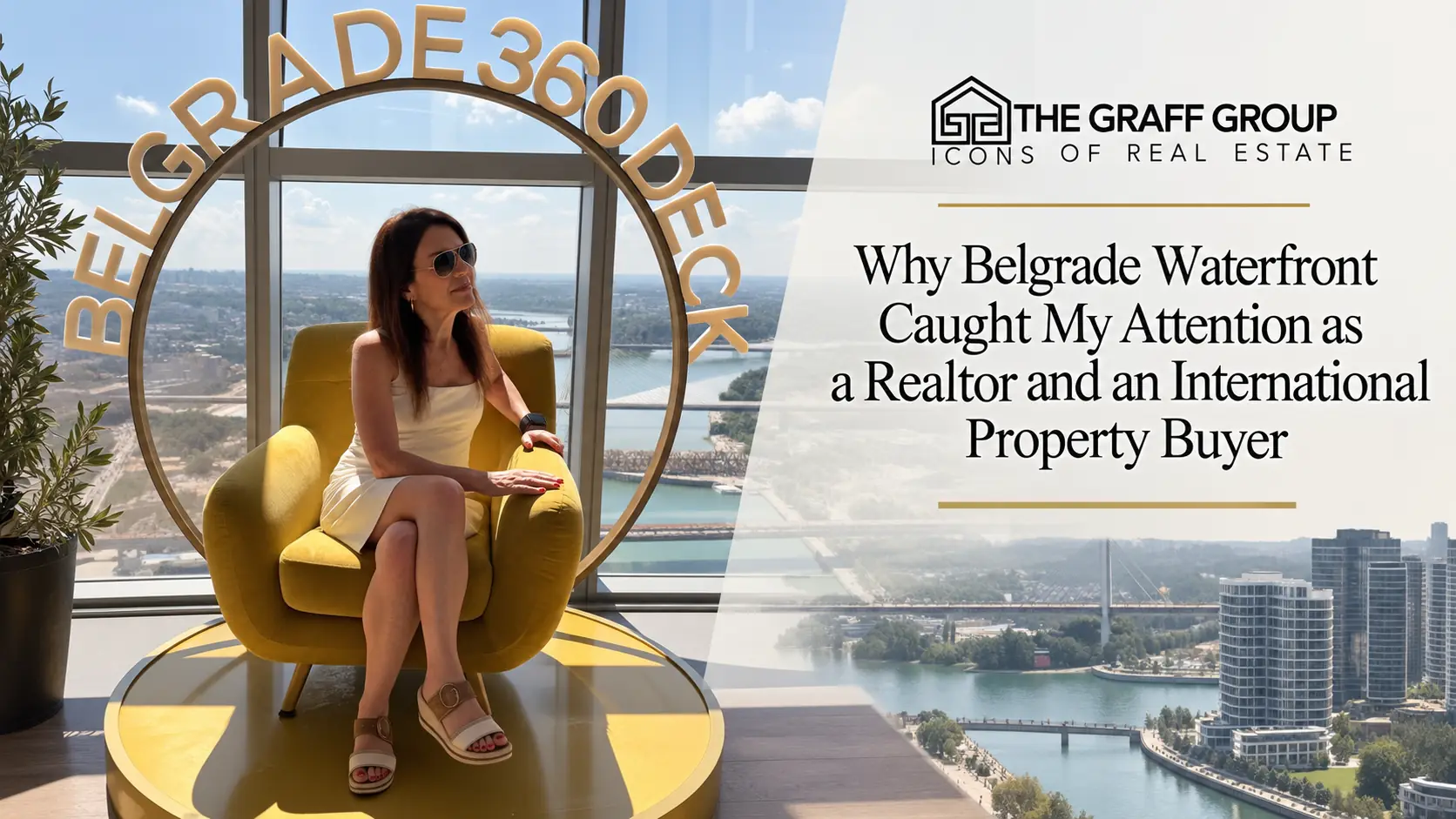
Then we went up Kula Belgrade, the striking tower that has become a landmark on the city’s skyline.
You purchase a ticket to visit the Belgrade 360 Deck on the 41st floor, 155 metres above the city. We went up, had coffee and looked out over Belgrade and the Sava River. It gives you an entirely different perspective on both the city and the magnitude of what is being built below.
Connected to all of this is The St. Regis Belgrade.
And it is stunning.
The hotel occupies part of Kula Belgrade and includes restaurants, spa and fitness facilities, while the tower also contains private St. Regis branded residences.
This is where the concept starts to become particularly interesting to an international buyer.
You could potentially own a property in a walkable waterfront community where restaurants, cafés, luxury shopping, hotels, fitness, entertainment, green space and the river are effectively outside your door.
For someone considering a second home, European base or investment property, that lifestyle component deserves attention.

What interested me most was what hasn’t been built yet.
There is another element that I always think about when looking at real estate: timing.
Do you buy somewhere after everything has already been completed and established or while the neighbourhood is still evolving?
Belgrade Waterfront reports that approximately 10,000 apartments have already been sold since the project began, with roughly 6,600 apartments completed in 34 buildings as of May 2026.
But construction continues.
That doesn’t automatically make something a good investment. Future appreciation should never be assumed simply because development is happening around you.
It does, however, make me curious.
What happens to values as more of the master plan is completed?
What will the marina add?
How will increased tourism and international recognition affect demand?
Which buildings, floor plans and views are likely to remain the most desirable over time?
And what are the ownership, tax, financing, rental and resale implications for a Canadian or other foreign purchaser?
Those are the questions I would want answered before purchasing.
Price per square foot or square metre isn’t the whole story
One thing decades in real estate has taught me is that buyers can become overly focused on price.
But value is more complicated than that.
Two apartments in the same development can perform very differently depending upon the building, floor, exposure, view, layout, amenities and future construction surrounding them.
A beautiful river view today isn’t quite as valuable if another building is eventually going directly in front of it.
That’s why understanding the master plan matters.
Interestingly, current offerings within Belgrade Waterfront range considerably. For example, one currently marketed building starts at €3,316 per square metre plus VAT, while other residences occupy a much more premium luxury category.
That tells me this isn’t one real estate market. There are different segments within the development itself.
And that is exactly why I would never recommend buying simply because someone says, “Belgrade is inexpensive.”
The better question is:
What am I buying, where within the development am I buying it, and why should this particular property remain desirable?
Would I consider buying there?
After seeing it firsthand?
I would certainly investigate it.
Belgrade surprised both Steve and me. It has an incredible combination of history and old-world European character, but this particular part of the city feels distinctly modern, international and ambitious.
I also think there is something fascinating about watching a major city reinvent an underutilized waterfront.
But international real estate requires another layer of due diligence.
Before purchasing, I would want independent Serbian legal and tax advice. I would want to understand foreign ownership rules, closing costs, VAT where applicable, property taxes, rental regulations, property management, financing, currency considerations and ultimately what happens when I want to sell and repatriate my money back to Canada.
The beautiful apartment is the fun part.
The structure of the investment is equally important.
Why I’m sharing this
Over the years, I have built relationships with realtors and real estate professionals in different parts of the world because our clients don’t always stop needing real estate advice when they leave Toronto.
Sometimes they’re relocating.
Sometimes they’re downsizing here and buying a second home somewhere else.
Sometimes they’re simply looking at real estate as part of a larger investment or lifestyle decision.
Belgrade Waterfront is one of those places that made me stop and say:
This deserves a closer look.
Not because every person should rush out and buy property in Serbia.
But because when you see this scale of investment, infrastructure and development happening in the centre of a European capital, along a major river and surrounded by a growing lifestyle community, it’s worth asking questions.
And that’s exactly what Steve and I did.
We walked it.
We toured it.
We met with a local agent.
We asked questions.
And, naturally, I came home with even more questions.
Because whether I’m looking at a property in Toronto, Belgrade or anywhere else in the world, my philosophy is the same:
Don’t start by asking, “Should I buy it?”
Start by understanding exactly what you’re buying — and then decide whether it makes sense for you.